
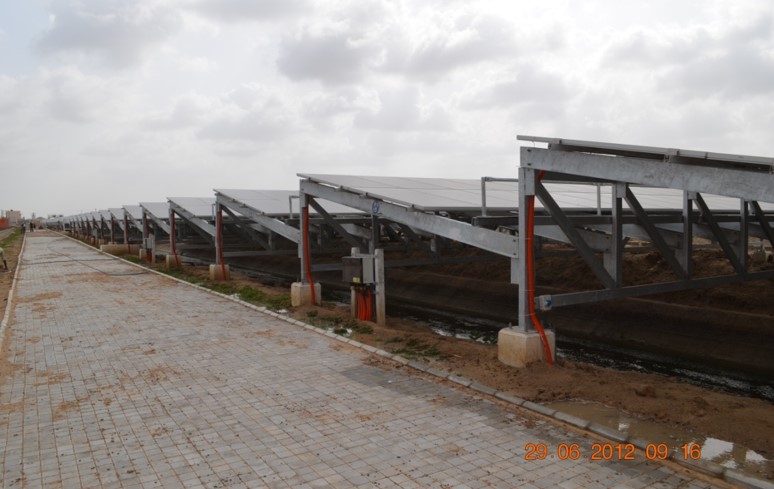
India’s pursuit of 500 GW of non-fossil-fuel generation capacity by 2030 is, at heart, not an engineering challenge but a land challenge. The transition from concentrated thermal generation to distributed, land-intensive renewable infrastructure has placed acreage at the centre of every project’s economics, every developer’s risk register, and every lender’s term sheet. Yet, land in India is a state subject, governed by a fragmented patchwork of revenue codes, tenancy laws, and ceiling statutes that were never designed for utility-scale renewable energy.
This four-part series moves from the macro problem (why land is the binding constraint), to the technical calculus (matching technology to terrain), to the acquisition machinery (lease, purchase, and the state-by-state rulebook), and finally to the bankability and equity frontier (where investor-grade rights meet just-transition realities). The objective is to give developers, investors, and policymakers a single integrated reference for navigating one of the most consequential resource-allocation problems in India’s energy transition.
Why India’s 500 GW Ambition Lives or Dies on Acres
The arithmetic of an energy transition
India crossed a generational threshold in 2025. As of October that year, total installed power capacity reached 505 GW, of which non-fossil sources contributed more than 50 percent — a milestone the country hit in June 2025, fully five years ahead of its Paris Agreement commitment. Solar capacity stood at 132.85 GW by November 2025 (a 41 percent year-on-year jump), wind at 54 GW, and aggregate renewable capacity at roughly 250 GW. To reach the 500 GW non-fossil target by 2030, India must add another 250 GW in five years — roughly 50 GW annually, every year, without interruption.
Behind these headline numbers lies a quieter, more stubborn variable: land. Unlike thermal plants — where a 1,000 MW unit fits comfortably on 200 to 300 hectares — utility-scale solar requires four to five acres per megawatt, and onshore wind demands a much larger macro-footprint due to aerodynamic spacing. Achieving 500 GW will require the strategic aggregation of tens of thousands of square kilometres of contiguous, technically suitable, legally clean, and socially negotiated land. Recent geospatial assessments identify roughly 3,343 GWp of feasible ground-mounted solar potential across 27,571 square kilometres of suitable wasteland — sufficient on paper, but heavily skewed toward a handful of states and constrained at every step by fragmented title, regulatory variation, and community contestation.
Land is no longer a preliminary step in project development. It is the primary determinant of viability, timeline adherence, and capital bankability.
Why land sits at the constitutional fault line
The structural difficulty begins with the Constitution. Land is a State Subject under the Seventh Schedule, which means that tenancy laws, agricultural ceiling acts, conversion procedures, stamp duty rates, and local revenue practices vary materially across the twenty-eight states and eight union territories in which renewable developers operate. There is no national land acquisition framework purpose-built for renewable energy. The Right to Fair Compensation and Transparency in Land Acquisition, Rehabilitation and Resettlement (LARR) Act, 2013 sets a federal floor — including an 80 percent consent threshold for private acquisition and a mandatory Social Impact Assessment where 400 or more families are displaced — but operates alongside, not above, the state codes.
This jurisdictional reality has two operational consequences. First, developers operating across multiple states must build state-specific legal teams and master locally idiosyncratic processes such as Maharashtra’s Class-II tenure rules, Karnataka’s deemed conversion of agricultural land, and Rajasthan’s Land Revenue Rules of 2007. Second, policy reform — even when intent is unanimous — moves at the speed of state legislatures. A telling example is Andhra Pradesh: in March 2026, the state passed the Assigned Lands (Prohibition of Transfers) Amendment Bill, unlocking 26.43 lakh acres of historically restricted land for renewable leasing under the AP Integrated Clean Energy Policy 2024. The reform is projected to attract ₹10 lakh crore in investment and create 7.5 lakh jobs, with assignees guaranteed a net annual rent of ₹31,000 per acre, escalating five percent every two years. The promise is enormous; replicating it in eight other states will take a decade.
A working typology: the five land categories that decide your project
Every renewable project ultimately gets sited on one of five land types, each with distinct acquisition mechanics, cost structures, and risk profiles. The first is Revenue Land — state-owned wasteland and uncultivated scrub — which the Ministry of New and Renewable Energy (MNRE) and State Nodal Agencies (SNAs) actively channel toward developers via the Solar Parks Scheme. Because the state acquires under eminent domain for a recognised public purpose, the LARR consent threshold does not apply, gestation periods compress dramatically, and developers receive plug-and-play parcels at concessional rates. The second is Private Land, where direct market negotiations produce either freehold purchase or long-term lease. The structural pain here is fragmentation: a 100 MW solar project demanding 400 acres can require negotiations with hundreds of titleholders, any one of whom can hold the whole array hostage.
The third category, Agricultural Land, is a subset of private land subject to additional friction. National and state policy strongly discourages diversion of multi-cropped fertile parcels; only fallow or mono-cropped land is generally permitted, and even then a statutory conversion to Non-Agricultural (NA) status is mandatory. NA conversion involves multiple departments — revenue, town planning, pollution control — and is one of the single largest sources of project delay in the system. The fourth is Assigned Lands — historically granted to landless or marginalised cultivators with restrictions on sale or commercial lease. These were locked out of the renewable boom for decades. Andhra Pradesh’s 2026 amendment is the most ambitious unlock to date, and its design — guaranteed annuities, retained titles, full assignee consent — will likely become the template for similar reforms in Telangana, Karnataka, and Tamil Nadu.
The fifth and most contested category is Forest and Ecologically Sensitive Land, governed by the Forest (Conservation) Act, 1980 and the Wildlife Protection Act, 1972. Diversion requires Stage-I and Stage-II clearances, compensatory afforestation at twice the diverted area, and Net Present Value payments. Litigation risk is severe; developers systematically avoid these areas except where transmission Right-of-Way leaves no alternative. A category that increasingly behaves like its own sixth class is community commons — including Rajasthan’s Oran sacred groves and Gujarat’s pastoral commons — where the absence of formal titles complicates both acquisition and ethics. The Rajasthan High Court ruled in 2021 that allotments of community lands to renewable developers had been made arbitrarily by the revenue department without considering land usage purposes or social impact, signalling judicial appetite to scrutinise revenue-side discretion.
Where the land actually is: a state-by-state map
India’s renewable potential clusters geographically. Rajasthan leads with 23 GW of installed solar capacity and the Bhadla Solar Park — 5,783 hectares delivering 2,245 MW — anchoring the western desert. The state targets 30 GW of solar from its arid Jodhpur, Bikaner, Jaisalmer, and Barmer districts. Gujarat hosts what is set to become the world’s largest single renewable installation: the Khavda Renewable Energy Park in the Rann of Kutch, where Adani Green Energy is developing 30 GW across 72,400 hectares of government wasteland under a 50-percent-in-three-years, 100-percent-in-five-years milestone covenant. As of mid-2025, Adani had commissioned over 5,355 MW at Khavda — a single-site achievement that demonstrates the asymmetric efficiency of the state-led wasteland model.
Madhya Pradesh and Uttar Pradesh have emerged as the second-tier giants. UP’s Bundelkhand region — Lalitpur, Jhansi, Jalaun, Chitrakoot — is being developed as a 3,565 MW solar belt, while MP is targeting 50 percent of annual demand from RE by 2030 with ₹50,000 crore of committed investment by 2027. Madhya Pradesh also hosts the largest floating solar installation in India: the Omkareshwar Floating Solar Park on the Narmada reservoir, currently 278 MW operational and scaling to 600 MW. Andhra Pradesh, Karnataka, and Tamil Nadu form the southern cluster, combining wind corridors with assigned-land unlocks and aggressive repowering. Tamil Nadu, with 10,790 MW of installed wind, has effectively saturated its prime corridors and now leads the country in repowering policy. Odisha is the silent strategic giant: its 4,795 MW of pumped storage potential, anchored by reservoirs like Upper Indravati and Balimela, will be critical to balancing the variable output of the western and southern clusters as battery storage matures.
The takeaway for the next chapter
The first-order question — is there enough land? — has a “qualified yes” for an answer. The harder questions follow: which technologies fit which terrain, how does a developer move from a satellite image to a registered lease, and what does it cost in time, capital, and social capital to do so legally and ethically. Chapter 2 turns to the suitability calculus — the technical, hydrological, geological, and demographic parameters that determine whether a parcel is, in fact, the right parcel. Chapter 3 addresses the acquisition machinery itself. Chapter 4 closes the loop on bankability and the equity frontier. Land may be India’s biggest renewable bottleneck — but it is also the asset class that, properly structured, can convert the energy transition into the most inclusive industrial mobilisation in the country’s modern history.